
Last Updated on October 28, 2026 by Sufyan Shaikh
Preparing for an Annual General Meeting (AGM) involves more than sending a meeting notice. A housing society secretary must coordinate documents, prepare the agenda, organise attendance records, support the presentation of reports and ensure that the meeting’s proceedings are properly documented.
If you are a housing society secretary in Maharashtra, this AGM checklist will help you organise the work before, during and after the meeting.
Use the checklist as a practical working guide and adapt it to your society’s registered bye-laws and applicable legal requirements.
What Is an AGM Checklist for a Housing Society Secretary?
An AGM checklist is a list of tasks and documents that helps the secretary prepare for the Annual General Meeting and follow up on decisions afterwards.
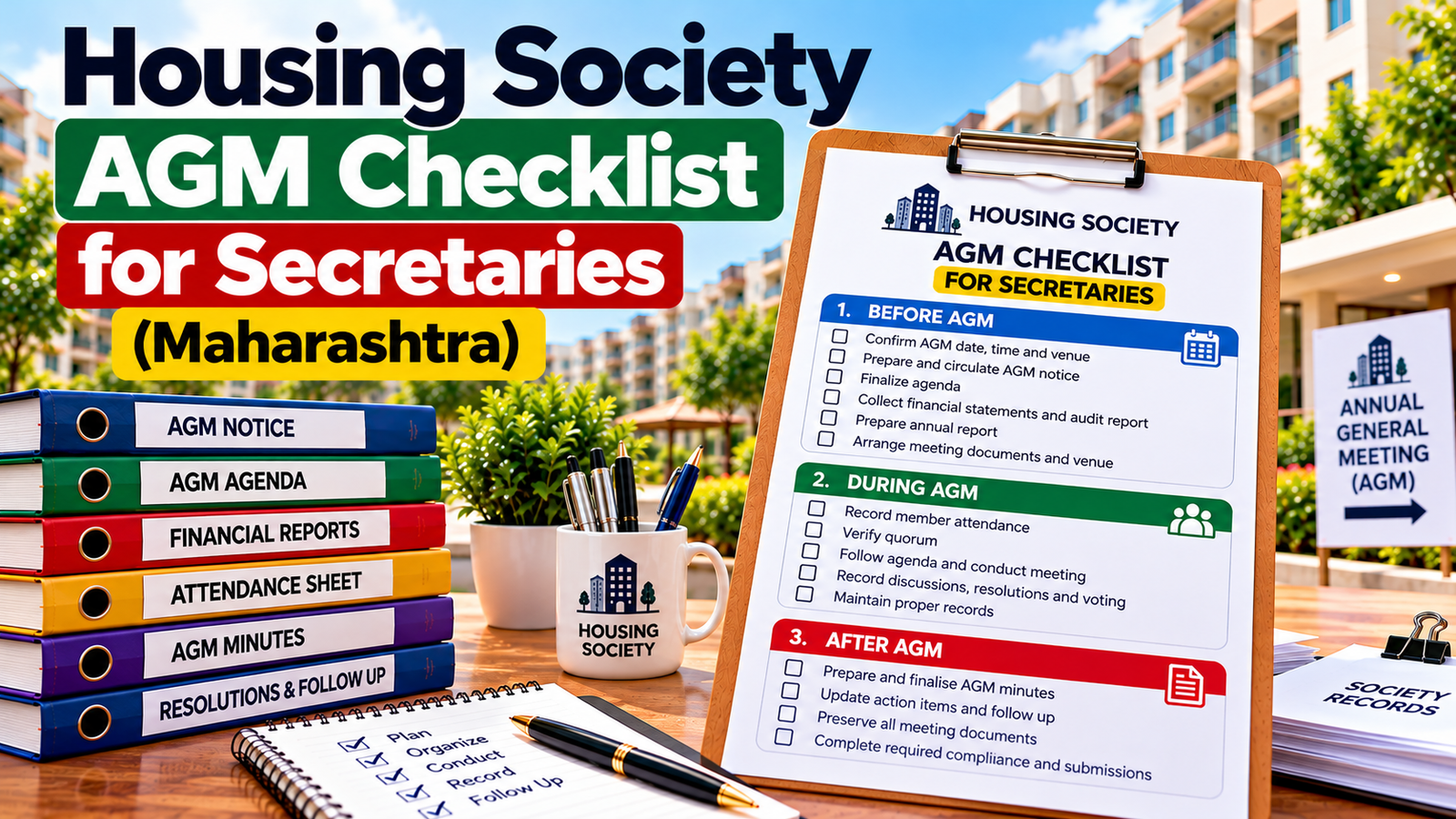
It generally covers three stages:
- Before the AGM: Notice, agenda, reports, accounts and meeting arrangements.
- During the AGM: Attendance, quorum, agenda discussions, resolutions and voting records.
- After the AGM: Minutes, action items, recordkeeping and required follow-up.
A checklist helps reduce the risk of missing important documents or administrative steps.
1. Before the AGM: Preparation Checklist
Start preparing well in advance of the proposed meeting date. Some tasks depend on information from the auditor, treasurer, committee or other service providers.
A. Confirm the AGM schedule and procedure
-
Confirm the proposed meeting date, time and venue.
-
Check the applicable AGM deadline and notice requirements.
-
Review the society’s registered bye-laws and current legal requirements.
-
Confirm who is authorised to convene the meeting and issue the notice.
-
Coordinate with the chairman, treasurer and managing committee.
-
Identify documents and reports that must be placed before members.
-
Arrange the meeting venue and required facilities.
Important: Do not assume that the notice period or AGM procedure is identical for every society. Verify the requirements applicable to your society before issuing the notice.
B. Prepare and circulate the AGM notice
-
Draft the AGM notice with the correct society details.
-
Include the meeting date, time and venue.
-
Prepare a clear and appropriately detailed agenda.
-
Include required information about the business to be considered.
-
Attach supporting documents where required or appropriate.
-
Obtain the required approval or authorisation for issuing the notice.
-
Circulate the notice using the applicable method and within the required period.
-
Retain a copy of the notice and evidence of circulation or service.
Avoid adding important decision-making items casually after the notice has been issued. Check whether any proposed change requires further notice or other procedural steps.
C. Collect financial documents
Coordinate with the treasurer and auditor to obtain the relevant documents for the financial year.
-
Audited financial statements, as applicable.
-
Auditor’s report.
-
Income and expenditure details.
-
Balance sheet and other required financial statements.
-
Maintenance collection and outstanding dues summary.
-
Budget proposal for the next financial year, where applicable.
-
Status of audit observations and rectification measures.
-
Details of major expenses, repairs and projects.
-
Other financial information required for the AGM.
Check that figures are consistent across the documents. Do not present draft or unreconciled figures as final audited figures.
D. Prepare the annual report and activity summary
-
Prepare the managing committee’s activity report, where applicable.
-
Summarise completed maintenance and repair work.
-
List significant projects and administrative activities.
-
Note major unresolved issues and proposed next steps.
-
Prepare an update on member complaints and common-area issues.
-
Summarise planned work for the coming year.
-
Verify names, dates, amounts and project statuses.
-
Obtain any required review or approval before circulation or presentation.
Clearly distinguish completed activities from work that is pending or merely proposed.
E. Organise meeting documents
Prepare a meeting folder containing the documents relevant to the agenda.
-
AGM notice and agenda.
-
Previous AGM minutes.
-
Relevant committee meeting minutes.
-
Annual report and financial documents.
-
Audit report and rectification updates.
-
Proposed budget and supporting estimates.
-
Repair quotations and project details, where relevant.
-
Draft resolutions, if appropriate.
-
Attendance sheets.
-
Other supporting documents required for the agenda.
F. Arrange attendance and venue
-
Print sufficient copies of the attendance sheet.
-
Arrange seating and suitable meeting facilities.
-
Keep copies of the notice and agenda available.
-
Arrange a writing surface, pens and any presentation equipment.
-
Prepare a way to identify members and verify relevant eligibility where necessary.
-
Make arrangements for members who require reasonable accessibility assistance.
-
Assign someone to help organise documents and attendance if needed.
2. During the AGM: Meeting-Day Checklist
Use this section to keep the meeting organised and ensure that important proceedings are recorded accurately.
A. Opening the meeting
-
Record the meeting’s actual start time.
-
Record the attendance of members using the appropriate register.
-
Check quorum under the applicable requirements.
-
Record the quorum outcome.
-
Ensure the meeting is chaired according to the applicable procedure.
-
Follow the notified agenda and relevant meeting rules.
Do not assume that the meeting can proceed with decision-making simply because several members are present. Confirm the applicable quorum and any consequences if it is not met.
B. Follow the agenda
-
Take up the agenda items in the appropriate order.
-
Present the relevant reports and documents.
-
Record important questions and clarifications.
-
Record the actual decision on each item.
-
Record resolutions accurately where they are proposed and passed.
-
Record voting outcomes where relevant.
-
Note material objections or dissent where required.
-
Record any item deferred for further information or approval.
The minutes should distinguish between a matter that was discussed, a proposal that was made and a resolution that was actually passed.
C. Financial and administrative matters
-
Ensure the relevant financial information is presented.
-
Record questions and responses on important financial matters.
-
Note audit observations and rectification updates.
-
Record the actual outcome of any budget or expenditure proposal.
-
Identify matters requiring further approval or investigation.
-
Record follow-up actions and responsible persons.
D. Closing the meeting
-
Confirm whether all agenda items have been addressed.
-
Record any permitted business taken up under the meeting procedure.
-
Note pending matters and next steps.
-
Record the actual closing time.
-
Ensure the attendance and supporting records are collected and preserved.
3. After the AGM: Post-Meeting Checklist
The secretary’s work continues after the meeting ends.
A. Prepare the minutes
-
Prepare a factual draft of the AGM minutes.
-
Record the meeting date, venue and attendance details.
-
Summarise the discussions under the relevant agenda items.
-
Record resolutions and decisions accurately.
-
Include voting outcomes and material objections where appropriate.
-
List action items, responsible persons and agreed deadlines.
-
Follow the applicable procedure for finalising, circulating and authenticating the minutes.
Check the relevant legal requirements and registered bye-laws for the applicable deadlines and process.
B. Follow up on resolutions and decisions
-
Prepare an action tracker based on decisions actually made.
-
Assign each action to the appropriate person or body.
-
Record target dates where agreed.
-
Obtain quotations or additional information where directed.
-
Confirm further approvals required before implementing a decision.
-
Track progress and report outstanding items at an appropriate subsequent meeting.
A resolution does not remove the need to obtain any additional statutory, contractual or administrative approval that may be required.
C. Update society records
-
Preserve the AGM notice and evidence of circulation.
-
Retain the attendance sheet.
-
Maintain the final minutes in the prescribed record.
-
Keep the relevant reports and financial documents.
-
Preserve supporting documents for resolutions and major decisions.
-
Update the committee’s action tracker.
-
Complete any applicable filings, submissions or compliance steps by their required deadlines.
Not every AGM requires the same follow-up. Determine which filings and actions apply to your society and the decisions made at the meeting.
4. Master AGM Checklist for Secretaries
Use this consolidated checklist when preparing for an AGM.
Before the meeting
-
Verify the applicable AGM date and procedure.
-
Prepare and circulate the notice.
-
Finalise the agenda.
-
Collect financial statements and audit documents.
-
Prepare the annual activity report.
-
Organise supporting documents.
-
Print attendance sheets.
-
Arrange the venue and meeting materials.
During the meeting
-
Record attendance.
-
Verify quorum.
-
Follow the agenda.
-
Record important discussions.
-
Document resolutions and actual voting outcomes.
-
Record pending matters.
-
Note start and closing times.
After the meeting
-
Prepare the minutes.
-
Follow the required finalisation and circulation procedure.
-
Update the action tracker.
-
Preserve the meeting records.
-
Complete applicable follow-up and compliance tasks.
5. Documents a Housing Society Secretary Should Keep Ready
| Document | Purpose |
|---|---|
| AGM notice | Informs members about the meeting |
| AGM agenda | Identifies the business to be considered |
| Previous AGM minutes | Provides a record of the previous meeting |
| Annual report | Summarises society activities |
| Audited financial statements | Presents the relevant financial position |
| Auditor’s report | Records the auditor’s findings |
| Attendance sheet | Documents meeting attendance |
| Draft resolutions | Helps organise proposed decisions |
| Supporting quotations and reports | Provides information for agenda items |
| Minutes of the AGM | Records the proceedings and decisions |
| Action tracker | Monitors implementation of decisions |
The documents required will depend on the AGM agenda and the applicable rules and bye-laws.
6. Common AGM Preparation Mistakes to Avoid
Issuing the notice late: Verify the applicable notice period before circulation.
Preparing an incomplete agenda: Make sure important business is described clearly enough for members to understand what will be considered.
Using unverified financial figures: Reconcile financial summaries with the relevant accounts and reports.
Ignoring quorum requirements: Confirm the applicable requirements rather than relying only on the number of people present.
Recording proposed decisions as approved: Minutes must reflect the actual outcome.
Forgetting post-meeting deadlines: Track the applicable deadlines for minutes, records and required submissions.
Failing to assign follow-up actions: Record who is responsible for each action and any agreed deadline.
7. Maharashtra-Specific Compliance Reminder
Housing societies in Maharashtra should follow the applicable Maharashtra Co-operative Societies Act, rules, circulars and their registered bye-laws when conducting AGMs and maintaining records.
Before relying on a checklist, verify the current requirements relating to:
- AGM timing and notice.
- Required financial statements and audit-related documents.
- Quorum and voting procedures.
- Minutes preparation, finalisation and circulation.
- Statutory submissions and other compliance obligations.
Official resources include the Maharashtra Co-operation Department’s documents and its Acts and Rules section.
This checklist is an administrative aid, not a substitute for the society’s registered bye-laws or legal advice.
Frequently Asked Questions
1. What should a housing society secretary do before an AGM?
The secretary should verify the meeting procedure, prepare the notice and agenda, coordinate the required reports and financial documents, arrange attendance records and organise the venue and supporting materials.
2. Which documents are required for a housing society AGM?
Relevant documents may include the AGM notice, agenda, previous minutes, annual report, financial statements, audit report, attendance sheet and supporting documents for agenda items. Confirm the exact requirements for the society and meeting.
3. What should a secretary do if the AGM quorum is not met?
The chairperson and secretary should follow the procedure specified by applicable law and the registered bye-laws. The consequences and next steps depend on the governing requirements; do not assume the meeting can proceed with all business as normal.
4. When should AGM minutes be prepared?
The secretary should prepare the draft promptly and follow the applicable process and deadlines for finalisation, circulation and authentication. Verify the current requirements rather than relying on a generic timeline.
5. Should the secretary track AGM resolutions after the meeting?
Yes. A practical approach is to maintain an action tracker showing the decision, responsible person, target date and progress. This helps the committee monitor implementation while ensuring that any additional required approvals are obtained.
Conclusion
An organised AGM helps a housing society conduct its annual business more effectively and maintain clear records. By using a checklist before, during and after the meeting, the secretary can prepare the documents, record the proceedings accurately and track follow-up actions.
Customise this checklist for your society, verify the applicable Maharashtra requirements and retain the relevant records in accordance with your registered bye-laws.
Disclaimer: This article is for general informational purposes and is not legal advice. Verify current legislation, rules, circulars and your society’s registered bye-laws before relying on it for formal compliance.
Also Read: