
Last Updated on October 28, 2026 by Sufyan Shaikh
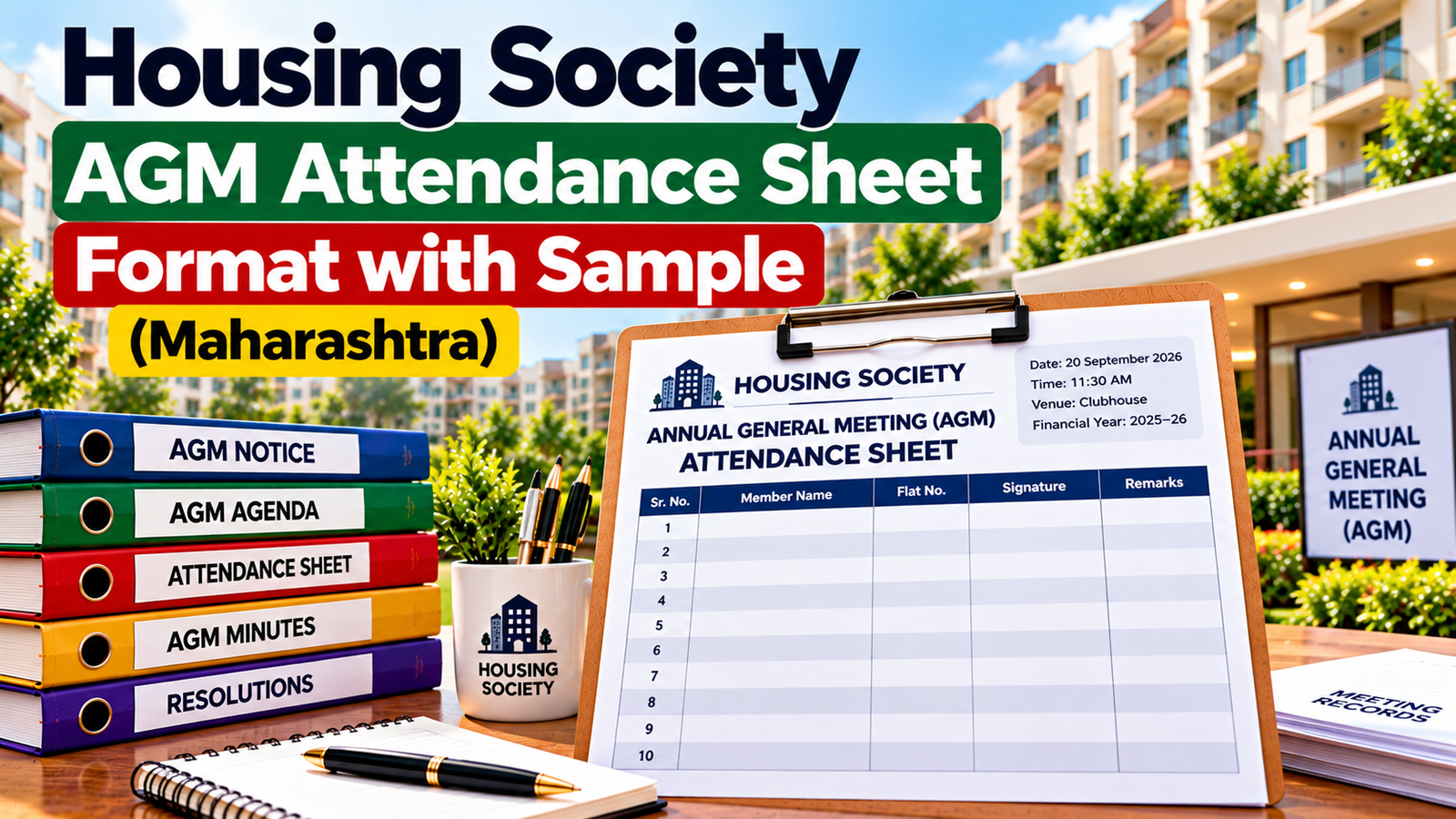
An Annual General Meeting (AGM) is an important meeting where housing society members discuss annual accounts, committee activities, maintenance, repairs and other society matters. Maintaining an attendance sheet helps the society keep a record of the members who attended the meeting.
If you are a housing society chairman, secretary, treasurer or committee member, this guide provides a simple housing society AGM attendance sheet format that you can copy into Microsoft Word or Excel and customise for your society.
What Is an AGM Attendance Sheet?
An AGM attendance sheet is a document used to record the people attending a housing society’s Annual General Meeting. It generally includes the member’s name, flat number and signature, along with the meeting date and other relevant details.
The attendance record can help the society document participation and maintain supporting records of the meeting.
Housing Society AGM Attendance Sheet Format
Use the following sample template for your society’s AGM.
[NAME OF THE CO-OPERATIVE HOUSING SOCIETY LTD.]
Registration No.: [Society Registration Number]
Address: [Complete Society Address]
ANNUAL GENERAL MEETING — ATTENDANCE SHEET
Financial Year: [YYYY–YY]
Meeting Date: [DD/MM/YYYY]
Meeting Time: [Time]
Venue: [Society Clubhouse / Office / Other Venue]
| Sr. No. | Member Name | Flat No. | Signature | Remarks |
|---|---|---|---|---|
| 1 | [Member Name] | [Flat No.] | ||
| 2 | [Member Name] | [Flat No.] | ||
| 3 | [Member Name] | [Flat No.] | ||
| 4 | [Member Name] | [Flat No.] | ||
| 5 | [Member Name] | [Flat No.] | ||
| 6 | [Member Name] | [Flat No.] | ||
| 7 | [Member Name] | [Flat No.] | ||
| 8 | [Member Name] | [Flat No.] | ||
| 9 | [Member Name] | [Flat No.] | ||
| 10 | [Member Name] | [Flat No.] |
Total attendees recorded: [Number]
Prepared / verified by: [Name]
Designation: [Secretary / Authorised Person]
Signature: ____________________
This is a general template. Adapt the columns and attendance procedure to your society’s requirements.
Sample AGM Attendance Sheet
The following example uses fictional details to show how the attendance sheet can be filled in.
GREEN VALLEY CO-OPERATIVE HOUSING SOCIETY LTD.
Pune, Maharashtra
AGM Attendance Sheet — Financial Year 2025–26
Meeting Date: 20 September 2026
Time: 11:30 AM
Venue: Society Clubhouse
| Sr. No. | Member Name | Flat No. | Signature | Remarks |
|---|---|---|---|---|
| 1 | Amit Patil | A-101 | [Signature] | |
| 2 | Neha Deshmukh | A-102 | [Signature] | |
| 3 | Rahul Joshi | B-201 | [Signature] | |
| 4 | Priya Kulkarni | B-202 | [Signature] | |
| 5 | Sameer Shah | A-301 | [Signature] |
Names and flat numbers are fictional examples. Use the actual meeting details and attendance records for your society.
What Information Should an AGM Attendance Sheet Include?
A useful attendance sheet generally includes the following details:
- Society name: The registered name of the housing society.
- Registration number: Include it where appropriate for identification.
- Meeting date and venue: Clearly identify the AGM being recorded.
- Financial year: State the period covered by the AGM.
- Member name: Record the attendee’s name legibly.
- Flat number: Helps identify the member’s unit.
- Signature: Provides a record of attendance where signatures are used.
- Remarks: Use only when necessary, such as to record a relevant attendance clarification.
If a representative attends on behalf of a member, record the details and authorisation only in accordance with the applicable rules and bye-laws. Do not assume that every form of representation or proxy is permitted.
How to Prepare an AGM Attendance Sheet in Excel
You can prepare a printable attendance sheet in Microsoft Excel by following these steps:
- Open a new Excel workbook.
- Add the society name and registration details at the top.
- Enter the AGM date, venue and financial year.
- Create columns for serial number, member name, flat number, signature and remarks.
- Add enough blank rows for the expected attendees.
- Adjust column widths so members can write their signatures clearly.
- Set the print layout to landscape if needed.
- Review the sheet before printing and retain the completed record with the society’s meeting documents.
For larger societies, prepare additional pages and repeat the meeting details on each page so the sheets remain identifiable.
Important Points When Recording AGM Attendance
1. Keep the attendance sheet with the meeting records
Maintain the completed attendance sheet with the relevant AGM documents, such as the notice, agenda and minutes, according to the society’s recordkeeping procedures.
2. Verify attendance carefully
Ensure entries are legible and that the record reflects the people who actually attended. Do not fill in signatures or attendance details on behalf of another person.
3. Distinguish attendance from voting rights
An attendance sheet records participation. It does not, by itself, establish that a person is entitled to vote on every matter or that the meeting has met its quorum requirements.
4. Check the quorum separately
The chairperson or authorised person should verify quorum according to the applicable legal provisions and the society’s registered bye-laws. The number of signatures on a sheet should not automatically be treated as proof of quorum.
5. Protect members’ personal information
Use the attendance sheet for its intended administrative purpose. Store it securely and avoid publishing members’ signatures or personal details unnecessarily.
Is an AGM Attendance Sheet Mandatory for Maharashtra Housing Societies?
Housing societies should follow the applicable requirements for conducting general body meetings and maintaining meeting records. The exact procedure and records required should be checked against current Maharashtra co-operative law, applicable rules, circulars and the society’s registered bye-laws.
An attendance sheet is a practical way to document participation, but it should not be assumed to replace other prescribed records or procedures.
For official information, consult the Maharashtra Co-operation Department’s documents and Acts and Rules pages.
Common Mistakes to Avoid
- Leaving out the AGM date or society name.
- Using a sheet that does not provide enough space for signatures.
- Recording attendance inaccurately.
- Treating a signature as automatic proof of voting eligibility.
- Assuming attendance numbers alone establish quorum.
- Failing to preserve the completed attendance record.
- Sharing members’ signatures or personal information publicly without a valid reason.
Frequently Asked Questions
1. Who maintains the AGM attendance sheet?
The society’s authorised office-bearer or designated person generally coordinates attendance recording. Follow the society’s applicable meeting and recordkeeping procedures.
2. Can an AGM attendance sheet be prepared in Excel?
Yes. Excel is useful for preparing and printing an attendance sheet. Ensure the completed record is retained in the form and manner required by the society’s applicable procedures.
3. Is a member’s signature necessary on the attendance sheet?
A signature is a common way to record attendance, but the applicable requirements and any permitted alternative methods should be verified for your society.
4. Does an attendance sheet prove that the AGM had a quorum?
Not by itself. The attendance record is supporting evidence. Quorum must be assessed according to the applicable requirements, including member eligibility and any relevant meeting rules.
5. Should the attendance sheet be attached to AGM minutes?
It is useful to retain the attendance sheet with the AGM’s supporting records. Follow the society’s applicable recordkeeping requirements for how it should be stored and referenced.
Conclusion
A properly maintained AGM attendance sheet helps a housing society document participation and organise its meeting records. Use the sample format as a starting point, verify attendance carefully and check your society’s applicable requirements before using the sheet as an official record.
Disclaimer: This article is for general informational purposes and is not legal advice. Verify current Maharashtra co-operative law, rules, circulars and your society’s registered bye-laws before relying on the format for formal compliance.
Also Read: