
Last Updated on October 28, 2026 by Sufyan Shaikh
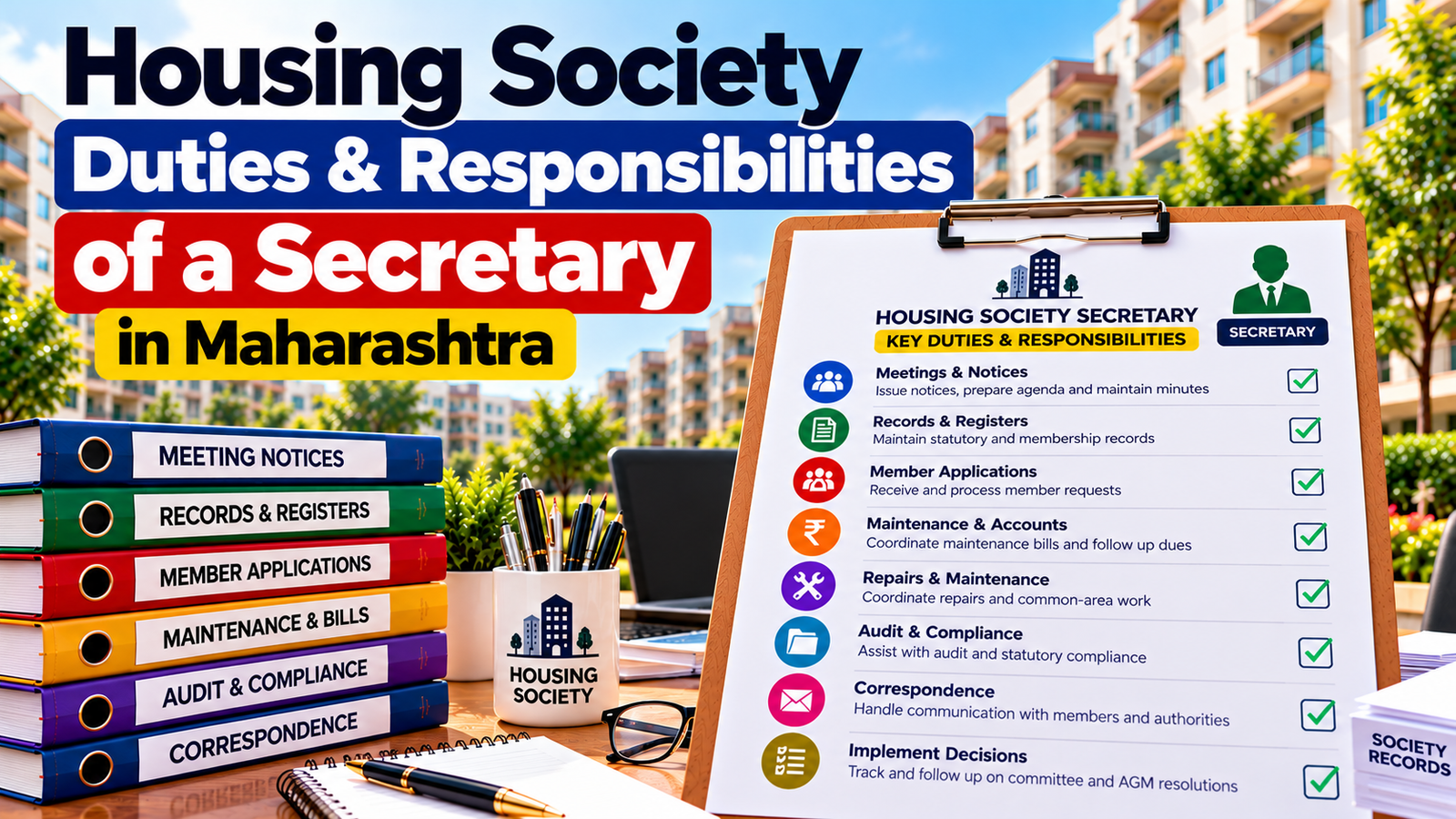
The secretary plays an important role in the day-to-day administration of a cooperative housing society. From issuing meeting notices and maintaining records to handling member applications and coordinating maintenance work, the secretary helps ensure that the society’s administrative activities run smoothly.
In Maharashtra, the secretary’s responsibilities are governed by the applicable cooperative society law, rules and the society’s registered bye-laws. The exact duties can vary depending on the applicable provisions and the society’s governance arrangements.
This guide explains the main duties and responsibilities of a housing society secretary in Maharashtra, with a practical checklist for everyday use.
Who Is the Secretary of a Housing Society?
The secretary is an office-bearer responsible for important administrative and recordkeeping functions of a cooperative housing society.
The role commonly involves coordinating with the chairman, treasurer, managing committee, members, auditors, contractors and relevant government authorities.
The secretary does not automatically have independent authority to make every society decision. Management responsibilities and decision-making powers must be exercised according to applicable law, the registered bye-laws and decisions of the competent society body.
1. Administrative Duties of a Housing Society Secretary
One of the secretary’s main responsibilities is maintaining the society’s administrative records and ensuring that routine work is properly documented.
Typical duties include:
- Maintaining society correspondence and official documents.
- Keeping statutory registers and other prescribed records up to date.
- Maintaining membership-related records and nomination details as required.
- Coordinating the issue of share certificates in accordance with applicable requirements.
- Receiving and processing applications submitted by members.
- Maintaining records of important decisions and actions.
- Coordinating with the chairman and other office-bearers on pending matters.
- Organising the society’s administrative files and records for reference.
The secretary should ensure that records are accurate, accessible to authorised persons and preserved according to applicable requirements.
2. Duties Related to AGM and Society Meetings
Meetings are an important part of cooperative housing society governance. The secretary commonly coordinates meeting-related administration.
Responsibilities may include:
- Preparing and issuing meeting notices through the authorised process.
- Preparing agendas for managing committee and general body meetings.
- Arranging the documents required for the meeting.
- Maintaining attendance records.
- Recording the minutes of meetings.
- Documenting resolutions and decisions accurately.
- Tracking actions arising from meetings.
- Preserving meeting notices, minutes and supporting documents.
For AGMs and Special General Body Meetings (SGMs), the secretary should verify the applicable notice periods, agenda requirements, quorum rules and other procedures before the meeting is convened.
Important: The secretary should not record a proposal as an approved resolution unless the decision was actually passed through the appropriate process.
3. Maintaining Society Records and Registers
Proper recordkeeping helps the society manage its affairs and respond to member requests, audits and official enquiries.
Depending on the applicable requirements, records may include:
| Record | Purpose |
|---|---|
| Member register | Records membership details |
| Nomination register | Records nominations and changes as applicable |
| Share certificate records | Tracks certificates issued to members |
| Managing committee minutes | Records committee proceedings |
| General body minutes | Records AGM and other general body proceedings |
| Society correspondence | Maintains a record of official communications |
| Application register | Tracks applications and requests received |
| Financial records | Supports the society’s accounting and reporting processes |
| Audit-related records | Supports audit follow-up and rectification |
The precise records required should be checked against the current law, rules and the society’s registered bye-laws.
4. Handling Member Applications and Complaints
Members may approach the society with requests relating to property transfers, nominations, repairs, parking, maintenance bills, access to records and other issues.
The secretary’s responsibilities may include:
- Receiving and acknowledging applications.
- Recording the date and nature of each request.
- Checking whether the required documents have been provided.
- Placing matters before the managing committee or other competent body when required.
- Communicating decisions made through the proper process.
- Tracking pending requests and follow-up actions.
- Maintaining relevant correspondence and records.
The secretary should not reject an application or make a final decision solely on personal preference. The response should follow the applicable procedure and the authority assigned to the relevant person or body.
Examples of member requests
| Member request | Typical administrative action |
|---|---|
| Request for a share certificate | Verify the records and follow the applicable process |
| Nomination update | Check the required documents and update records where authorised |
| Flat transfer application | Verify documentation and process the application under applicable rules |
| Repair complaint | Record the complaint and coordinate inspection or committee review |
| Request to inspect society records | Follow the applicable record-access procedure |
| Maintenance bill query | Coordinate verification with the person responsible for accounts |
5. Maintenance Bills and Outstanding Dues
The secretary may have an administrative role in preparing or issuing society charge demands and following up on outstanding dues, depending on the society’s arrangements and applicable bye-laws.
Typical responsibilities include:
- Coordinating the preparation and distribution of maintenance bills.
- Ensuring that billing information is based on the society’s records.
- Bringing payment defaults to the managing committee’s attention.
- Coordinating with the treasurer or accountant on discrepancies.
- Maintaining records of reminders and member communications.
- Supporting the authorised recovery process where required.
The secretary should not alter charges arbitrarily or impose penalties without the necessary authority and compliance with applicable rules and bye-laws.
6. Financial Administration and Coordination
The treasurer or accountant may handle particular accounting functions, but the secretary often coordinates administrative activities relating to financial records and reporting.
These activities may include:
- Coordinating with the treasurer and accountant.
- Helping organise financial statements and supporting documents for meetings.
- Maintaining records of approved financial decisions.
- Coordinating with the auditor on required information.
- Tracking pending audit observations and rectification actions.
- Ensuring that relevant financial matters are placed before the appropriate committee or general body.
- Preserving records of approvals and related correspondence.
The secretary should not independently approve expenditure, sign financial transactions or commit society funds unless authorised under the applicable arrangements.
7. Coordinating Repairs and Common-Area Maintenance
Housing societies need regular maintenance of common facilities, including lifts, pumps, electrical systems, CCTV, water supply systems and common areas.
The secretary may help coordinate this work by:
- Recording repair complaints and maintenance requirements.
- Arranging inspections and obtaining quotations when authorised.
- Placing proposals before the competent approving body.
- Coordinating with approved contractors and service providers.
- Tracking work progress and completion.
- Maintaining invoices, work orders and relevant correspondence.
- Reporting unresolved issues to the managing committee.
For major repairs, structural work or significant expenditure, the society should obtain the approvals and technical advice required under applicable procedures.
8. Correspondence With Government Authorities and External Agencies
A society may need to communicate with the Registrar of Cooperative Societies, local authorities, auditors, banks, utility providers and other organisations.
The secretary may be responsible for:
- Drafting and maintaining official correspondence.
- Submitting documents when authorised.
- Keeping copies of letters, acknowledgements and responses.
- Coordinating requests for information from competent authorities.
- Tracking deadlines and required follow-up.
- Placing significant communications before the managing committee.
Documents should be submitted or commitments made only by persons authorised to act on behalf of the society.
9. Audit and Compliance Responsibilities
A housing society must comply with the applicable requirements relating to accounts, audit, records and statutory submissions.
The secretary may assist by:
- Coordinating with the auditor.
- Arranging requested books, registers and supporting documents.
- Tracking audit observations.
- Coordinating preparation of rectification reports where applicable.
- Bringing unresolved compliance matters to the committee’s attention.
- Tracking applicable filing and submission deadlines.
- Maintaining records of submissions and acknowledgements.
The secretary should not certify information as correct without an appropriate basis. Responsibility for an audit, certification or particular statutory filing depends on the applicable law and the person’s assigned role.
10. Implementing Committee and General Body Decisions
The secretary helps coordinate the implementation of decisions made by the competent society body.
For example, after a valid decision is taken to carry out an approved repair project, the secretary may coordinate documentation, communication, contractor follow-up and progress reporting.
Practical responsibilities include:
- Maintaining a list of resolutions and action items.
- Identifying the person responsible for each task.
- Tracking agreed timelines.
- Keeping evidence of work completed.
- Reporting delays or obstacles to the committee.
- Ensuring that additional approvals are obtained where required.
A secretary should not change a resolution or exceed the authority granted by it.
11. What Are the Limits of a Housing Society Secretary’s Powers?
The secretary has important administrative responsibilities, but the role is not unlimited.
The following principles are useful:
- Committee decisions: Matters assigned to the managing committee should be handled through the appropriate decision-making process.
- General body decisions: Matters reserved for the general body must follow the relevant procedure.
- Financial commitments: Expenditure and financial transactions must be authorised under applicable rules and society arrangements.
- Legal matters: Disputes, recovery proceedings and other legal actions must follow the prescribed process.
- Member applications: Requests must be handled fairly and in accordance with applicable requirements.
- Recordkeeping: Society records must be accurate and should not be altered to misrepresent decisions or events.
The chairman, secretary, treasurer and managing committee have different functions. A secretary should work within the authority granted by law, the registered bye-laws and valid decisions.
12. Daily, Monthly and Annual Checklist for a Housing Society Secretary
Daily or as required
-
Review incoming society correspondence.
-
Record member applications and complaints.
-
Follow up on urgent maintenance issues.
-
Update pending action items.
-
Maintain important communications and records.
Monthly or periodically
-
Review pending member requests.
-
Coordinate maintenance billing and outstanding dues follow-up.
-
Track repairs and contractor work.
-
Review committee action items.
-
Organise society records and financial documents.
-
Check upcoming compliance or submission deadlines.
Before and after the AGM
-
Verify the applicable AGM procedure and timeline.
-
Prepare the notice and agenda.
-
Coordinate annual reports and financial documents.
-
Arrange attendance and supporting records.
-
Record the actual proceedings and decisions.
-
Finalise minutes under the applicable procedure.
-
Track resolutions and required follow-up.
This checklist is a practical management aid, not a replacement for any prescribed statutory schedule.
13. What Happens If the Secretary Does Not Perform Their Duties?
If administrative responsibilities are not being carried out, the appropriate response depends on the nature of the issue and the society’s governance arrangements.
Members may raise concerns through the society’s prescribed complaint process or place the matter before the competent committee or authority. Where necessary, further action may be available under applicable law.
A secretary should not be assumed to have unlimited personal liability for every society problem. Responsibility depends on the facts, the person’s actions or omissions, the applicable legal provisions and any relevant orders.
14. Official Rules and References for Maharashtra Housing Societies
The main legal framework includes the Maharashtra Co-operative Societies Act, 1960, applicable rules and the society’s registered bye-laws.
For reference, consult:
- Maharashtra Co-operation Department — Acts and Rules
- Maharashtra Co-operation Department — Official Documents
- Maharashtra Co-operative Societies Act, 1960 — text published by the Law and Judiciary Department
The official Act and government resources provide the starting point for verifying applicable requirements. Model bye-laws should not automatically be treated as the exact registered bye-laws of every society.
Frequently Asked Questions
1. What are the main duties of a housing society secretary in Maharashtra?
Common responsibilities include maintaining records, issuing meeting notices, recording minutes, handling member applications, coordinating correspondence, supporting financial administration and tracking committee decisions, subject to applicable law and bye-laws.
2. Can a housing society secretary make decisions independently?
Only within the authority granted under applicable law, the registered bye-laws and valid delegations or decisions. Matters requiring committee or general body approval should follow the prescribed process.
3. Is the secretary responsible for maintaining society records?
The secretary commonly has significant recordkeeping responsibilities. The exact records and duties should be verified against the applicable law, rules, registered bye-laws and society arrangements.
4. Can the secretary reject a member’s application?
An application should be assessed under the applicable requirements and procedures. The secretary should not reject it arbitrarily and may need to place the matter before the competent body.
5. Is the secretary responsible for society accounts and audits?
The secretary may coordinate financial records, audit documents and compliance follow-up. Specific accounting, approval and audit responsibilities depend on the society’s arrangements and applicable legal requirements.
6. What should members do if the secretary is not responding?
Members can submit a written request through the society’s prescribed process and retain a copy. If the issue remains unresolved, they can consider raising it with the competent society body or authority, depending on the matter and applicable procedure.
Conclusion
The housing society secretary plays a central role in administration, recordkeeping, meetings, member communication and compliance coordination. Performing these duties accurately and transparently helps the society maintain organised records and implement valid decisions.
For Maharashtra housing societies, the secretary should always work within the authority provided by applicable law, the society’s registered bye-laws and decisions of the competent body.
Disclaimer: This article is for general informational purposes and is not legal advice. Verify current Maharashtra legislation, rules, circulars and your society’s registered bye-laws before relying on it for formal compliance.
Also Read: