
Last Updated on October 29, 2026 by Sufyan Shaikh
When a new managing committee takes charge of a housing society, one of its first responsibilities is to obtain the records and information needed to manage the society properly.
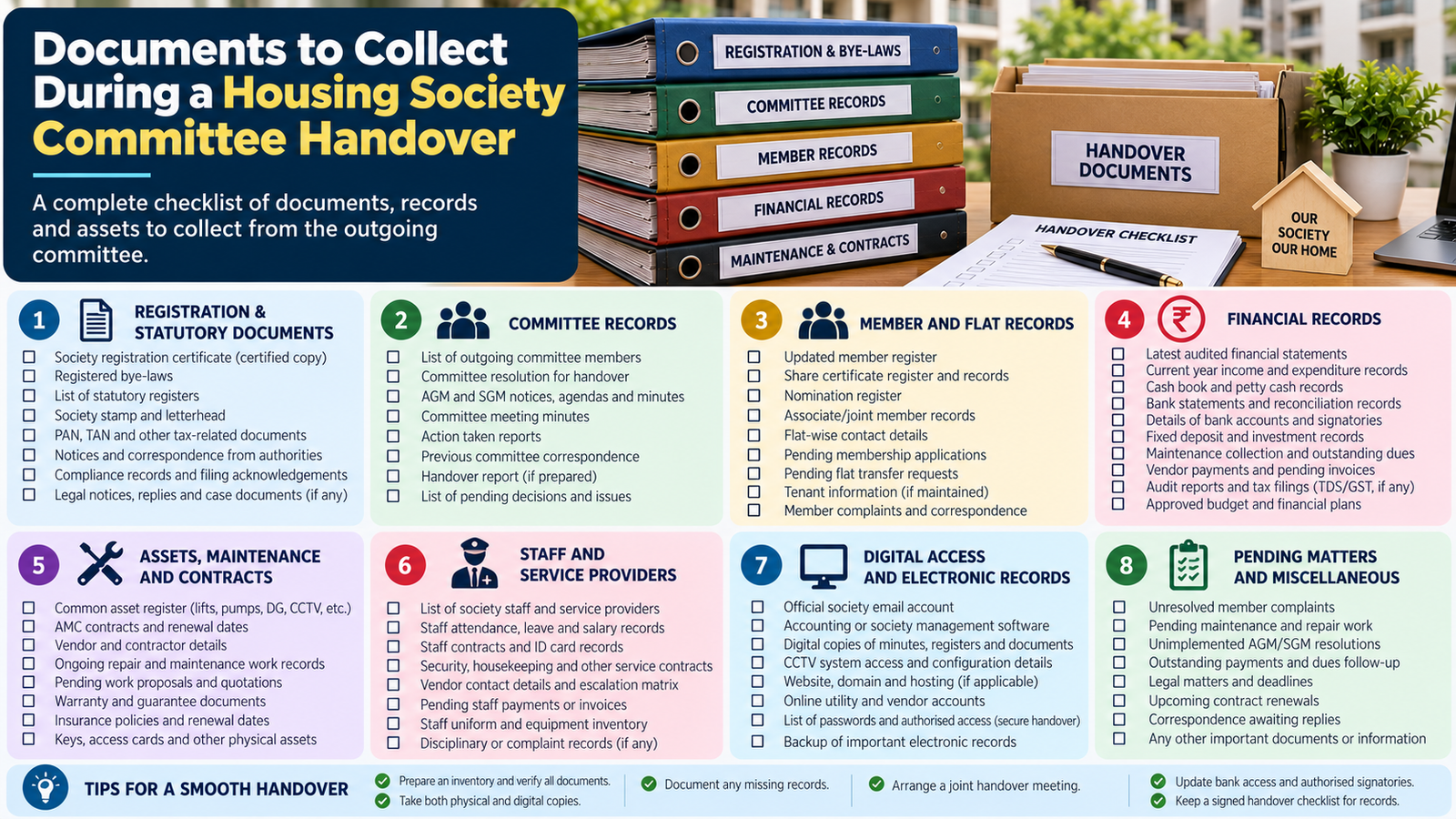
A committee handover involves more than collecting files. The incoming committee needs access to financial statements, meeting minutes, membership records, contracts, legal correspondence, maintenance information and details of pending work.
Missing documents can delay important decisions, make it difficult to resolve resident complaints and create uncertainty about payments, contracts and previous committee decisions.
This guide explains which documents to collect during a housing society committee handover, how to organise them and what to do when records are missing. It is designed for housing societies in Maharashtra, with practical guidance that can also help societies in other parts of India.
Why Is Document Collection Important During a Committee Handover?
A proper document handover helps the incoming committee understand the society’s current position and continue essential work without unnecessary disruption.
It helps the society:
- Understand its financial position and outstanding liabilities.
- Verify previous decisions made by the committee and general body.
- Access membership and nomination records.
- Track ongoing maintenance projects and service contracts.
- Respond to official notices and legal correspondence.
- Identify pending complaints, payments and compliance matters.
- Protect important records from loss or unauthorised access.
- Maintain continuity when office bearers change.
The incoming committee should verify the records received and document any missing items instead of assuming that everything is complete.
1. Society Registration and Statutory Documents
Begin with the core documents that establish the society’s identity, governance framework and official records.
Use this checklist:
-
Society registration certificate.
-
Current registered bye-laws and available amendment records.
-
Society registration number and relevant registration details.
-
Available statutory registers.
-
PAN and other applicable tax-related documents.
-
Society letterhead and official stamp.
-
Relevant correspondence with the Co-operative Registrar.
-
Notices, directions and orders received from government authorities.
-
Copies of legal notices, replies and case documents, where applicable.
-
Compliance records and filing acknowledgements.
-
Conveyance deed, property-related documents and land records held by the society, where applicable.
-
Details of any pending regulatory or legal matters.
Practical tip: Record whether each document is an original, certified copy, ordinary copy or digital scan. Do not treat a photocopy as an original merely because it is included in the handover file.
2. Committee and General Body Meeting Records
Meeting records help the incoming committee understand the decisions already made and the work that remains outstanding.
Collect the following:
-
Previous managing committee meeting minutes.
-
AGM and SGM notices.
-
AGM and SGM agendas.
-
General body meeting minutes.
-
Resolutions passed by the committee and general body.
-
Attendance records for meetings, where maintained.
-
Action-taken reports.
-
Committee member and office bearer details.
-
Records of resignations, appointments and vacancies, where applicable.
-
Previous committee correspondence.
-
Pending decisions and unresolved issues.
-
Records of objections or dissent recorded in meetings, where applicable.
Pay special attention to resolutions that have not yet been implemented. Record the decision, its current status, the next action and any relevant deadline.
3. Member and Flat Records
Membership documents are essential for managing ownership-related requests, nominations, communications and other society administration.
Collect the available records, including:
-
Updated member register.
-
Share certificate register and related records.
-
Nomination register and nomination documents.
-
Associate and joint member records, where applicable.
-
Flat-wise member contact directory.
-
Pending membership applications.
-
Pending flat transfer requests.
-
Correspondence concerning membership changes.
-
Member applications and written requests.
-
Complaint register and unresolved complaints.
-
Tenant information records, where maintained.
-
Records of outstanding member requests.
Member records contain personal information. Transfer them securely and restrict access to authorised persons.
4. Financial and Accounting Documents
Financial records deserve particular attention because the incoming committee needs to understand the society’s receipts, expenditure, assets and liabilities.
Use this checklist:
-
Latest available audited financial statements.
-
Current financial year’s income and expenditure records.
-
Receipts and payments records.
-
Cash book and petty cash records.
-
Bank statements.
-
Bank reconciliation statements.
-
Details of bank accounts and authorised signatories.
-
Fixed deposit and investment records.
-
Maintenance collection reports.
-
Outstanding member dues report.
-
Vendor payment records and pending invoices.
-
Payment vouchers and supporting bills.
-
Approved annual budget and expenditure records.
-
Details of loans, liabilities and financial commitments.
-
Audit reports and audit correspondence.
-
Audit observations and rectification status.
-
Applicable tax records and filing acknowledgements.
-
Records of reserve, sinking or other society funds, where applicable.
The incoming committee should reconcile important balances with available supporting documents and bank records. A document handover is not a substitute for an audit or independent financial verification.
Do not transfer banking credentials through an unsecured document or group chat. Changes to bank signatories must follow the bank’s prescribed process and the society’s required authorisations.
5. Maintenance, Repairs and Asset Documents
The new committee should know which assets the society owns, what condition they are in and which repairs or contracts are ongoing.
Collect:
-
Society asset register.
-
Inventory of lifts, pumps, generators and other equipment.
-
Lift maintenance and inspection records.
-
Water tank cleaning and water quality records.
-
CCTV system and maintenance information.
-
Fire safety equipment inspection records.
-
Electrical and plumbing maintenance records.
-
Repair proposals and approved quotations.
-
Work orders and contractor bills.
-
Ongoing repair project status reports.
-
Warranty and guarantee documents.
-
Annual maintenance contracts.
-
Insurance policies and renewal dates.
-
Contractor contact details.
-
Records of pending defects and complaints.
-
Keys, access cards and other physical assets.
For every ongoing project, record the approved scope, contractor, estimated or approved cost, payments made, work completed, pending work and next action.
6. Vendor, Contractor and Staff Documents
Housing societies often depend on security agencies, housekeeping contractors, maintenance providers and other service providers.
Collect the records that are relevant to the society’s operations:
-
Vendor and contractor contact directory.
-
Service agreements and contracts.
-
Contract renewal dates.
-
Security and housekeeping agreements.
-
Staff details and employment records maintained by the society.
-
Staff attendance, leave and salary records, where applicable.
-
Pending staff payments and vendor invoices.
-
Contractor escalation contacts.
-
Vendor performance reports or unresolved service complaints.
-
Equipment and inventory records issued to staff.
-
Details of pending contractual obligations.
Check upcoming renewals and payment deadlines so essential services are not disrupted.
Personal and employment records should be handled confidentially and transferred only for legitimate administrative purposes.
7. Legal and Authority Correspondence
The incoming committee should understand whether the society has any ongoing legal, regulatory or administrative matters.
Collect:
-
Notices received from the Co-operative Registrar or other authorities.
-
Replies submitted by the society.
-
Legal notices and responses.
-
Court or tribunal documents, if any.
-
Correspondence with advocates or professional advisers.
-
Records of pending disputes.
-
Orders or directions that require action.
-
Details of filing dates and upcoming deadlines.
-
Audit-related compliance correspondence.
-
Records relating to conveyance or redevelopment, where applicable.
Prepare a separate list of pending matters, including the current status, next action and relevant date. If a deadline is unclear, confirm it with the relevant professional or authority rather than assuming it can wait.
8. Digital Records and Authorised Access
Some of the society’s most important information may be stored electronically rather than in physical files.
Check for:
-
Official society email account.
-
Accounting or society management software.
-
Digital copies of meeting minutes and registers.
-
Digital copies of financial statements and invoices.
-
Cloud storage or document management accounts.
-
Online utility and service provider accounts.
-
Website, domain and hosting access, if applicable.
-
CCTV administration arrangements.
-
Backup copies of important records.
-
List of pending access changes.
-
Details of the person responsible for maintaining each system.
Transfer access through secure, authorised methods. Update passwords and permissions where appropriate, enable multi-factor authentication when available and avoid placing passwords directly in the handover report.
9. Pending Complaints, Decisions and Work
Documents alone may not explain the current status of every issue. The incoming committee should receive a written summary of pending work.
Prepare a list covering:
-
Unresolved resident complaints.
-
Pending maintenance and repair work.
-
Outstanding payments and dues follow-up.
-
Unimplemented AGM or SGM resolutions.
-
Pending membership or transfer applications.
-
Outstanding vendor commitments.
-
Legal and regulatory deadlines.
-
Insurance and contract renewals.
-
Replies awaited from authorities or service providers.
-
Any other matter requiring timely action.
For each item, record the issue, date raised, current status, documents available, next action and responsible person or role.
10. How to Organise the Handover Documents
Collecting records is only the first step. They must also be organised so the incoming committee can find and use them.
A practical filing structure is:
| Folder | Documents to include |
|---|---|
| 01 — Registration & Bye-Laws | Registration certificate, registered bye-laws and amendments |
| 02 — Committee & Meetings | Meeting notices, agendas, minutes and resolutions |
| 03 — Members | Membership registers, nominations and applications |
| 04 — Finance & Audit | Accounts, bank records, audit reports and tax documents |
| 05 — Maintenance & Assets | Asset register, repairs, warranties and maintenance contracts |
| 06 — Vendors & Staff | Service agreements, contact details and relevant staff records |
| 07 — Legal & Compliance | Authority correspondence, notices, orders and compliance records |
| 08 — Digital Records | Backup locations, system access details and account responsibilities |
| 09 — Pending Matters | Complaints, outstanding decisions, deadlines and follow-up actions |
| 10 — Handover Record | Inventory, discrepancies and signed handover acknowledgement |
Use the same folder names for physical files and digital folders where practical. Keep confidential records in appropriately restricted locations.
11. What If the Outgoing Committee Does Not Provide the Documents?
If records are missing or the outgoing committee does not provide them, the incoming committee should handle the situation methodically.
- Prepare a list of the missing documents and assets.
- Send a written request identifying each item.
- Preserve the request and any reply.
- Record the operational impact of the missing information.
- Identify alternative sources of copies, where appropriate.
- Secure the records and access already available to the society.
- Seek guidance from the appropriate Co-operative Registrar or a qualified professional if the issue remains unresolved.
Avoid making unsupported allegations. Document the facts and the steps taken to resolve the matter.
If the society has no functioning committee or the authority of the incoming or outgoing office bearers is unclear, obtain guidance on who is legally authorised to act.
12. Housing Society Committee Handover Document Checklist
Use this short checklist during the actual handover meeting.
-
Registration certificate and registered bye-laws received.
-
Committee and general body meeting records received.
-
Member, share certificate and nomination records received.
-
Financial statements, bank records and audit reports received.
-
Maintenance contracts and asset records received.
-
Vendor, contractor and relevant staff records received.
-
Legal and authority correspondence received.
-
Digital records and authorised access arrangements reviewed.
-
Pending complaints, decisions and deadlines documented.
-
Missing records and discrepancies listed.
-
Physical assets, keys and access cards accounted for.
-
Handover inventory reviewed and acknowledged by the relevant representatives.
-
A copy of the completed handover record retained by the society.
Mark each item as Received, Partially Received, Not Available or Pending Verification rather than marking everything complete without checking.
Frequently Asked Questions
1. Which documents are most important during a housing society committee handover?
Start with the society registration certificate, registered bye-laws, committee and general body minutes, membership registers, financial statements, bank records, audit reports, contracts and records of pending matters. The precise list depends on the society’s activities and circumstances.
2. Who should prepare the document handover inventory?
The outgoing committee should help identify and organise the records it holds. The incoming committee should check what has been received and document missing or incomplete items. The process should reflect the society’s actual governance arrangements and applicable requirements.
3. Should original documents be handed over?
Where original society documents are held by the outgoing committee, their location and transfer should be documented appropriately. Record whether each item is an original, certified copy or ordinary copy. If an original is missing, document the issue and take steps to locate or obtain an appropriate replacement.
4. What should the incoming committee do if financial records are incomplete?
Record the missing items, request supporting documents in writing and review the available bank statements, accounts and audit reports. Seek professional assistance where necessary. Do not assume that incomplete records alone establish financial misconduct.
5. How should digital records be transferred?
Use authorised and secure transfer methods. Check that important files are accessible, retain appropriate backups, update account permissions and change credentials where necessary. Avoid sharing passwords in general committee groups or public documents.
6. Is there one mandatory handover document checklist for all Maharashtra housing societies?
This article provides a practical administrative checklist, not a prescribed statutory form. The documents required in a particular situation may depend on the society’s registered bye-laws, applicable co-operative laws, rules, orders and circumstances.
Official Resources
For Maharashtra-specific requirements, consult the current official documents and seek professional guidance where needed:
- Maharashtra Co-operation Department — official documents
- Maharashtra Co-operative Societies Act, 1960 — text as on 6 June 2025
The published Act text may not include every later amendment. Verify the current applicable requirements before relying on a specific legal procedure.
Conclusion
A proper housing society committee handover depends on collecting the right documents, verifying what has been received and clearly recording what remains outstanding.
Use a structured inventory covering statutory records, meetings, members, finances, maintenance, contracts, legal matters, digital access and pending tasks. Keep the handover record securely with the society so the incoming committee can continue its work with greater clarity and accountability.
Disclaimer: This article provides general information and is not legal advice. The applicable requirements depend on current legislation, rules, registered bye-laws and the society’s circumstances. Seek guidance from the appropriate Co-operative Registrar or a qualified professional when necessary.
Also Read:
Duties and Responsibilities of a Housing Society Secretary in Maharashtra
Housing Society Committee Handover Checklist
What Happens When a Housing Society Committee Member Resigns?
What If No One Is Willing to Join the Housing Society Committee?