
Last Updated on October 29, 2026 by Sufyan Shaikh
The chairman of a housing society plays an important role in coordinating the managing committee, conducting meetings and supporting the effective administration of the society. The position involves leadership, communication and oversight, but it does not give the chairman unlimited authority over society decisions.
In Maharashtra, the chairman’s powers and responsibilities must be understood in the context of the Maharashtra Co-operative Societies Act, 1960, the applicable rules and the society’s registered bye-laws.
This guide explains the role of a housing society chairman, the decisions they can help make, the limitations they must observe and how they should work with the secretary, treasurer and other committee members.
What Is the Role of a Housing Society Chairman?
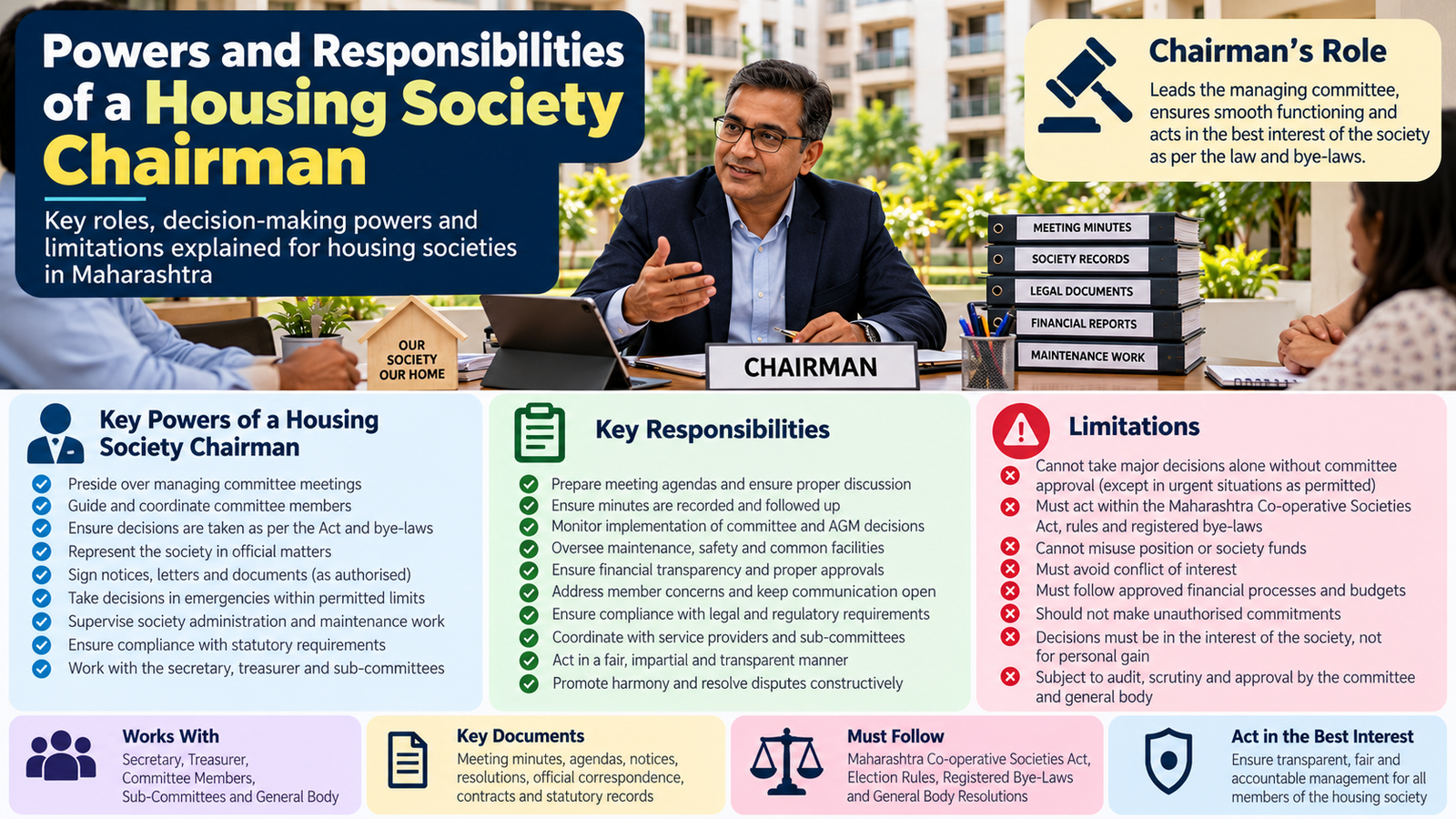
The chairman leads the managing committee and helps ensure that the society’s affairs are handled according to applicable laws, registered bye-laws and valid decisions of the committee and general body.
The chairman’s role commonly includes:
- Presiding over committee meetings and general body meetings as applicable.
- Encouraging orderly discussion and participation.
- Helping the committee follow its approved agenda and procedures.
- Supporting the implementation of valid committee and general body decisions.
- Coordinating with the secretary, treasurer and other committee members.
- Helping address administrative difficulties and member concerns.
- Promoting transparency, fairness and accountability.
The chairman must act within the authority provided by the applicable legal framework and the society’s registered bye-laws. The role should not be treated as a personal ownership or control position over the society.
Powers of a Housing Society Chairman
The exact powers depend on the applicable rules, registered bye-laws and valid decisions of the society. The following are common aspects of the role.
1. Presiding Over Meetings
The chairman generally presides over managing committee meetings and relevant general body meetings in accordance with the society’s governing procedures.
This includes helping maintain order, facilitating discussion and ensuring that agenda items are considered properly.
The chairman should not use the meeting to prevent legitimate discussion or disregard the applicable meeting procedure.
2. Coordinating Committee Decisions
The chairman helps the committee discuss issues and reach decisions through the prescribed process.
Examples include:
- Reviewing maintenance concerns.
- Discussing contractor performance.
- Considering member applications.
- Reviewing pending complaints.
- Monitoring previously approved work.
- Coordinating follow-up on committee decisions.
The chairman does not automatically have the power to make every decision independently. Matters requiring committee or general body approval must follow the relevant procedure.
3. Supporting Implementation of Resolutions
Once a valid resolution has been passed, the chairman may help monitor its implementation and coordinate with the secretary, treasurer or responsible committee members.
For example, if the committee approves a repair project within its authority, the chairman may help review progress reports and follow up on delays.
The chairman should not change an approved decision unilaterally where a further committee or general body decision is required.
4. Representing the Society in Official Matters
The chairman may represent the society in meetings or correspondence with authorities, contractors and other parties when authorised or permitted under the applicable rules and bye-laws.
This does not automatically mean the chairman can sign every document, enter every contract or make every financial commitment on the society’s behalf.
The required approval and signing authority should be verified for the particular transaction.
5. Coordinating Urgent Matters
Urgent situations, such as a serious water leak, a lift breakdown or a safety concern, may require prompt coordination.
The chairman can help arrange communication, bring the relevant people together and ensure that the matter reaches the authorised decision-makers.
Any emergency action must remain within the authority permitted by the applicable rules and society procedures. Urgency should not be used as a blanket justification for unauthorised expenditure or commitments.
Responsibilities of a Housing Society Chairman
Leadership involves more than conducting meetings. The chairman should help ensure that the committee functions effectively and that society matters are handled responsibly.
1. Ensure Meetings Are Conducted Properly
Work with the secretary to ensure meetings are organised according to the applicable procedure.
This includes supporting proper notice, agenda preparation, orderly discussion, accurate recording of decisions and follow-up on action items.
The secretary may be responsible for maintaining the official minutes and registers, while the chairman helps ensure that meetings are conducted effectively.
2. Monitor Implementation of Decisions
The chairman should help the committee track approved resolutions and identify delays or unresolved issues.
A decision tracker can record:
- Resolution or decision.
- Date of approval.
- Responsible person or committee.
- Current status.
- Pending action.
- Target date, where appropriate.
This makes it easier for the committee to review progress and report back to members.
3. Promote Financial Accountability
The chairman should support proper financial controls and ensure that financial matters are considered through the appropriate process.
Depending on the issue, this may include reviewing reports presented by the treasurer, monitoring approved expenditure and ensuring that financial decisions are documented.
The chairman should not bypass required approvals, interfere improperly with accounting records or treat society funds as personal funds.
4. Support Maintenance and Safety
The chairman can help coordinate discussions about building maintenance, common facilities, equipment and safety concerns.
Examples include:
- Reviewing reports of lift or pump breakdowns.
- Following up on approved repair work.
- Monitoring maintenance contractor performance.
- Ensuring that urgent safety issues are escalated.
- Reviewing progress on previously approved projects.
Technical assessments should be obtained from qualified professionals where necessary. The chairman should not substitute personal judgment for required engineering, safety or statutory inspections.
5. Address Member Concerns Fairly
The chairman should encourage a clear and consistent process for handling member complaints, applications and requests.
A fair approach involves recording the issue, referring it to the appropriate person or committee, communicating the status where appropriate and avoiding preferential treatment.
Members should be treated according to applicable law, registered bye-laws and valid society decisions.
6. Promote Compliance and Proper Recordkeeping
The chairman should support the committee in meeting its governance responsibilities, including following applicable requirements and preserving society records.
The committee should work with the secretary, treasurer, auditor and professional advisers as needed.
The chairman is not a substitute for the entire committee, the society’s auditor or a qualified legal adviser.
7. Encourage Cooperation Among Committee Members
Housing society management involves multiple roles. The chairman should promote cooperation between the secretary, treasurer and other committee members.
Clear task allocation, respectful communication and documented decisions help prevent misunderstandings and reduce dependence on a single office bearer.
What Are the Limits of a Housing Society Chairman’s Powers?
Understanding these limitations is just as important as understanding the chairman’s responsibilities.
Can the Chairman Make Decisions Without Committee Approval?
Not as a general rule. The chairman must follow the applicable law, registered bye-laws and valid authorisation.
Where a matter requires a committee or general body decision, the chairman should not treat personal preference as a substitute for the prescribed approval.
Can the Chairman Spend Society Money Independently?
The chairman should not assume unlimited authority over society funds. Payments and financial commitments must follow the society’s approved financial procedures, relevant authorisations and applicable requirements.
The exact signing and approval arrangements should be checked against the society’s records and registered bye-laws.
Can the Chairman Ignore a General Body Resolution?
A valid general body resolution cannot simply be disregarded because the chairman disagrees with it. The society must follow the applicable legal framework for implementing, reviewing or challenging a decision.
If a resolution appears unlawful or conflicts with a binding direction, the committee should obtain appropriate professional advice rather than ignoring it without a documented process.
Can the Chairman Punish a Member Personally?
The chairman should not impose personal penalties or restrictions simply because of a disagreement. Any action against a member must have a proper legal and procedural basis, including the required authority and opportunity to respond where applicable.
Can the Chairman Sign Any Society Document?
No blanket signing authority should be assumed. The person authorised to sign a particular document depends on the nature of the document, applicable requirements, the society’s registered bye-laws and valid authorisations.
Chairman vs Secretary vs Treasurer
The three office bearers have different functions and should work together.
| Role | Main focus |
|---|---|
| Chairman | Leadership, presiding over meetings, coordination and oversight |
| Secretary | Meeting notices, minutes, registers, correspondence and administrative records |
| Treasurer | Accounting, financial records, receipts, payments and financial reporting |
These are broad descriptions rather than an exhaustive legal allocation of duties. The applicable rules and the society’s registered bye-laws determine the specific responsibilities.
The chairman should not routinely take over the secretary’s recordkeeping role or the treasurer’s accounting role without proper authority and process.
Practical Checklist for a Housing Society Chairman
Use this checklist to review the society’s governance practices.
-
Meetings are organised according to the applicable procedure.
-
Agenda items are discussed in an orderly and fair manner.
-
Decisions are recorded by the authorised person.
-
Committee and general body resolutions are tracked.
-
Financial decisions follow the required approval process.
-
Member complaints and requests are handled consistently.
-
Maintenance and safety issues receive appropriate attention.
-
Society records are preserved and accessible to authorised persons.
-
Legal and regulatory matters are escalated when necessary.
-
Conflicts of interest are disclosed and managed appropriately.
-
Responsibilities are shared among the office bearers and committee.
-
Handover records are maintained when office bearers change.
What Should a Chairman Do If the Committee Disagrees?
Disagreements may arise over expenses, contractors, complaints, maintenance projects or the interpretation of bye-laws.
The chairman should encourage members to present their views, review relevant documents and follow the prescribed decision-making procedure.
If a matter cannot be resolved, it may need to be deferred for further information, referred to the general body where appropriate or reviewed with professional guidance.
The chairman should not suppress dissent or represent a disputed proposal as an approved resolution.
What Happens If a Chairman Misuses Their Powers?
If members believe that the chairman has acted beyond their authority, they should first identify the specific decision or action and gather relevant records.
Depending on the circumstances, they may:
- Review the applicable registered bye-laws and relevant resolution.
- Request a written explanation or place the issue before the appropriate committee.
- Use the society’s prescribed grievance or meeting procedures.
- Seek professional advice where legal or financial issues are involved.
- Approach the appropriate Co-operative Registrar or other competent authority where permitted.
The appropriate remedy depends on the facts and applicable law. A disagreement with the chairman does not, by itself, establish misconduct.
Frequently Asked Questions
1. What are the main powers of a housing society chairman?
The chairman’s role commonly involves presiding over meetings, coordinating committee work, supporting the implementation of valid decisions and representing the society when authorised. The exact powers depend on applicable law, rules and registered bye-laws.
2. Can a chairman take decisions without consulting the committee?
The chairman should not independently decide matters that require committee or general body approval. Any authority to act independently must come from the applicable legal framework or valid authorisation.
3. Is the chairman more powerful than the secretary?
The chairman and secretary have different functions. The chairman generally leads meetings and supports coordination, while the secretary typically handles notices, minutes, registers and correspondence. Neither should disregard the powers and responsibilities assigned to the other under the applicable rules and bye-laws.
4. Can a chairman approve a major repair project alone?
A major repair project may require committee or general body approval, professional assessments, financial authorisation or other procedures depending on its nature. The chairman should verify the applicable requirements before committing the society.
5. Can members challenge a chairman’s decision?
Members may use the procedures available under applicable law, registered bye-laws and society governance processes. The correct route depends on the nature of the decision and the remedy sought.
6. Where can I check the chairman’s legal powers in Maharashtra?
Start with the Maharashtra Co-operative Societies Act, 1960, the applicable rules and your society’s registered bye-laws, including registered amendments. A model bye-law document is useful for reference but should not automatically be assumed to be identical to your society’s registered version.
Official Resources
For Maharashtra-specific requirements, consult:
- Maharashtra Co-operation Department — Acts and Rules
- Maharashtra Co-operative Societies Act, 1960 — official Act listing
- Commissionerate of Cooperatives and Registrar of Cooperative Society, Maharashtra
The official website may list model documents and statutory amendments separately. Verify the current applicable provisions and your society’s registered bye-laws before relying on a specific power or procedure.
Conclusion
The chairman of a housing society has an important leadership and coordination role, but that role operates within legal and procedural limits.
A responsible chairman helps the committee conduct meetings properly, implement valid decisions, address member concerns, maintain financial accountability and coordinate essential society work. Major decisions, expenditure and formal actions must follow the appropriate approval and authorisation process.
For Maharashtra housing societies, the safest approach is to consult the current law and registered bye-laws, document decisions accurately and ensure that the chairman, secretary, treasurer and other committee members work together transparently.
Disclaimer: This article provides general information and is not legal advice. The precise powers and responsibilities of a chairman depend on current legislation, applicable rules, registered bye-laws and the circumstances of the society. Seek advice from the appropriate Co-operative Registrar or a qualified professional where necessary.
Also Read:
Duties and Responsibilities of a Housing Society Secretary in Maharashtra
Housing Society Committee Handover Checklist
What Happens When a Housing Society Committee Member Resigns?
What If No One Is Willing to Join the Housing Society Committee?
Documents to Collect During a Housing Society Committee Handover